
The Day a Cocaine Dealer Taught Me Something About the Human Nervous System
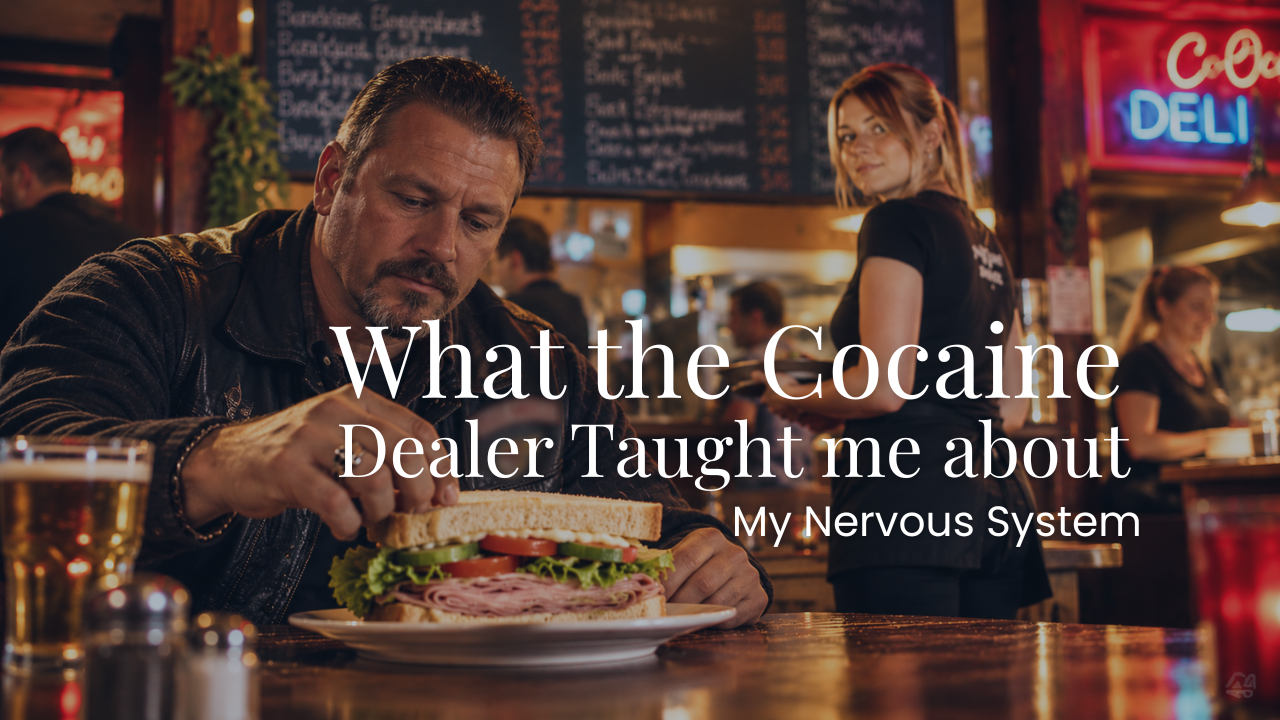
Or, how a very particular ham sandwich completely changed my perception of someone.
When I was living in Canada, I accidentally got myself a job in a strip club.
As you do.
In my defence, it was advertised as a show pub.
Now, I don't know about you, but where I come from, a show pub sounds like somewhere you might find a band, a few beers and perhaps some questionable karaoke.
Apparently, in Canada, it can mean something entirely different.
I didn't discover this until after I'd accepted the job.
But I needed the money, and everyone assured me that my position as a server (that's Canadian for waitress) was strictly a fully clothed affair.
Excellent. Clothes on. Bills paid. What could possibly go wrong?
Well, as it turned out, this wasn't just any strip club.
It was also a Hells Angels bikie clubhouse.
Yep.
Welcome to Canada, Larissa.
Needless to say, the place attracted some rather colourful characters.
And one of those characters was a man named Richard.
Hello Richard. And his bloody sandwich.
Richard was a big, tall, intimidating bloke.
The kind of bloke you probably wouldn't approach to ask for directions.
And, according to the locals, he was also the local cocaine dealer.
Lovely.
Now, I wasn't into drugs, and I certainly wasn't accustomed to hanging out with drug dealers.
So I'd already formed a pretty clear opinion of Richard.
Not my kind of people. Best avoided.
And Richard did absolutely nothing to improve that opinion.
You see, every single day, Richard would come into the pub and order the same sandwich.
But not just any sandwich.
Oh no.
Richard had requirements.
The bread had to be buttered right to the edges.
Then came the lettuce.
Then the ham.
Then the tomato.
Then the cucumber.
And finally, the mayonnaise.
MAYONNAISE. LAST.
God forbid someone put the cucumber before the tomato or missed a millimetre of butter.
Because Richard would march that sandwich straight back to the counter and, in his deep, gruff voice, demand another one.
Honestly, you'd think we were handling classified government documents rather than making lunch.
Every time we saw him coming, we'd roll our eyes.
Here we bloody go again.
To us, Richard was rude, aggressive, demanding and potentially dangerous.
And we had plenty of reasons to keep our distance.
Or so we thought.
Then one afternoon, everything changed.
It was a fairly ordinary day at the pub.
Richard was sitting alone, quietly enjoying his meticulously constructed sandwich.
I was working the floor when two men I'd never seen before walked in.
Out-of-towners.
I approached their table to take their order.
"Can I get you something?"
"Yeah, yeah," one of them replied.
I pulled out my notepad.
But instead of ordering, he looked me up and down.
"You're a beautiful girl, you know."
Righto.
"Thanks. What would you like to order?"
"My cousin's a photographer. He loves photographing beautiful women."
Oh, here we go.
"Mate, I didn't come down in the last shower. Do you want something to eat or not?"
He said yes.
So I stood there, pen poised.
And he continued talking about his cousin.
Fantastic.
I tried to walk away.
He grabbed my arm.
I pulled away and told him to let go.
Out of the corner of my eye, I noticed Richard glance over from his table.
Then he went back to eating his sandwich.
I returned to the men's table a little later.
Same story.
More comments.
More nonsense.
Another attempt to leave.
Another hand around my arm.
By now I was getting seriously fed up.
I wasn't there to entertain these blokes. I was there to take their bloody lunch order.
I tried one last time.
"Are you going to order anything?"
And once again, the man grabbed my arm.
But this time, something happened.
Something I absolutely did not see coming.
Richard put down his sandwich.
Now, if you understand anything about Richard at this point, you'll appreciate the significance of that sentence.
Richard. Put. Down. His. Sandwich.
He got up.
Walked straight towards our table.
And before I could even register what was happening, he grabbed the man by the scruff of his shirt, reefed him out of his chair and marched him towards the exit.
The swinging doors flew open.
And Richard threw him straight out onto the footpath.
Just like that.
He dusted off his hands.
Walked back inside.
Looked at me and said, in that same deep, gruff voice:
"There you go, Aussie. You don't have to worry about him anymore."
And then he went back to his sandwich.
I stood there.
Stunned.
What. The. Actual. Hell.
I managed to thank him.
The other bloke Mr "my cousin photographs beautiful girls" was with had suddenly developed an urgent need to be somewhere else.
Funny that.
I walked into the kitchen, where my boss was standing with his jaw practically on the floor.
He looked at me.
I looked at him.
And then he said something I'll never forget.
"You know what? We like him now, don't we?"
And without missing a beat, I replied:
"Yes. Yes, we do."
And here's where this story gets interesting.
Richard hadn't suddenly become a different person.
He was still Richard.
Still intimidating.
Still demanding his sandwiches be made with military precision.
Still someone whose lifestyle and choices were very different from mine.
And throwing someone out of a pub certainly isn't how I'd recommend handling every difficult situation.
But in that moment, he had stepped in when someone was repeatedly ignoring my boundaries.
He'd noticed.
He'd acted.
And he had helped me.
Something I hadn't expected from him at all.
Richard hadn't changed. But the story I was telling myself about Richard had.
Before that afternoon, when I saw him walking towards me, I anticipated trouble.
Afterwards?
I saw someone who had looked out for me.
Someone I could feel grateful towards.
Someone I no longer viewed through exactly the same lens.
And it all happened in a matter of seconds.
Your nervous system doesn't just respond to what's happening. It responds to what it thinks is happening.
This is something I find fascinating about being human.
Our brains are constantly interpreting the world around us.
Drawing on past experiences, learned beliefs, memories, expectations and the information coming in through our senses.
And much of that interpretation happens before we've consciously thought things through.
Is this safe?
Is this threatening?
Can I trust this person?
Do I need to protect myself?
Those interpretations help shape how our nervous system responds.
When we perceive danger, we may become more vigilant, tense or defensive.
When we perceive support, it may become easier to relax, connect and feel at ease.
But here's the really interesting part.
Our perception isn't always the whole truth.
Sometimes we're responding to what's actually happening.
Sometimes we're responding to what happened to us years ago.
Sometimes we're responding to a belief we've carried for so long that we've forgotten it's even a belief.
And sometimes, like my experience with Richard, we simply don't have the full picture.
Now, to be clear, my initial caution around Richard wasn't necessarily wrong. And his one act of kindness didn't magically make him a safe person in every situation.
That's an important distinction.
But the experience gave me new information.
And that new information changed how I related to him.
What if the story you're telling yourself isn't the only story?
Think about someone in your own life.
Someone who irritates you.
Someone you find difficult.
Someone who triggers a reaction in you before they've even opened their mouth.
Maybe it's a family member.
A colleague.
Your partner.
Or perhaps it's not another person at all.
Perhaps it's a story you've been telling yourself.
I'm not good enough.
People always let me down.
I have to do everything myself.
It's not safe to speak up.
These stories can become so familiar that we stop questioning them.
And our bodies can respond as though they're established facts.
But what happens when we become curious?
When we stop for a moment and ask:
Is this what's actually happening, or is this the meaning I've learned to give it?
That question doesn't mean ignoring red flags, excusing poor behaviour or pretending everything is wonderful.
It simply creates space.
Space to notice.
Space to question.
Space to see something we might have missed.
And sometimes, that little bit of space is enough to change how we feel, how we respond and what becomes possible next.
The lesson I've carried with me
I often talk about the relationship between our nervous system, our perceptions and the stories we tell ourselves.
Because when our internal state changes, the world can genuinely seem different.
And when we begin to see something differently, our internal state can change too.
Our state influences our story. And our story can influence our state.
It's a two-way conversation.
One that is happening inside us all the time.
And sometimes, all it takes to interrupt an old story is one unexpected experience.
One new piece of information.
One moment that makes us question what we thought we knew.
For me, that moment came courtesy of a cocaine dealer in a Canadian strip club.
Who would have thought?
And to this day, whenever I think about the power of perception, I remember Richard.
Not because he was perfect.
Not because I suddenly approved of everything he did.
But because he reminded me that there is often more to a person, a situation and even ourselves than the story we've been telling.
And that, my friends, is something worth remembering.
Although I still reckon the mayonnaise could have gone on before the cucumber.
The stories we carry without even realising it
This is one of the things I find most fascinating about the work I do with clients.
Because sometimes the story we're responding to isn't about what's happening today at all.
It's about something that happened 10, 20, 30 or even 50 years ago.
An experience that felt threatening, humiliating, frightening or deeply painful at the time.
And in that moment, particularly as a child, we may have made a decision about ourselves, other people or the world.
I'm not good enough.
I'm not safe.
People always leave me.
I can't trust anyone.
And here's the kicker.
We can grow up, move on, build careers, raise families and create entirely new lives, yet still find ourselves responding through the lens of those old experiences.
Let me give you a few examples from my work, with identifying details left out.
One client had spent years sabotaging her own success.
Every time she received a promotion, something would happen. She'd find a way to undermine herself.
As we explored this pattern, we uncovered a childhood memory of accidentally dropping her father's lunch and being yelled at.
In that moment, she'd taken away a painful message:
I'm worthless. I'll never be good enough.
Years later, despite being a capable adult, that old belief appeared to be influencing how she responded to success.
Another client couldn't bring herself to stay away from home overnight.
As we explored what might be contributing to that fear, she recalled an experience at a resort as a child when a man had been peeping through her window.
She'd never consciously connected that experience with her reluctance to sleep away from home.
But suddenly, there was something worth exploring.
And another client carried a deeply held belief that she'd been abandoned.
Not just by her parents.
By EVERYBODY.
That was the story she knew. The story she felt. The story through which she interpreted so many of her relationships.
But as we explored her history, we brought attention to someone she'd almost completely overlooked.
Someone who had taken her in, cared for her and treated her like one of their own.
That didn't erase the pain of what she'd experienced.
But it introduced something her original story hadn't made room for.
She hadn't been abandoned by everybody.
And that distinction mattered.
Sometimes the past is still influencing the present
Our brains are extraordinary meaning-making machines.
They learn from experience, anticipate what might happen next and develop ways to protect us.
And sometimes those protective responses outlive the circumstances that helped create them.
What once felt necessary can become a pattern we no longer want.
People-pleasing.
Self-sabotage.
Avoiding conflict.
Struggling to trust.
Feeling unsafe when there's no obvious danger.
Constantly trying to prove our worth.
And often, we don't consciously connect these patterns to earlier experiences.
We might not have thought about a particular childhood event for decades.
Yet the emotional learning associated with it can still influence how we feel and behave.
The experience may be in the past, but the meaning we made of it can still be shaping our present.
And that's where I love to work.
This is what we explore in my 1:1 sessions
Through kinesiology, mind-body coaching and nervous system-informed practices, I help clients become curious about the patterns that keep showing up in their lives.
Not just what they're doing.
But why that response might have made sense in the first place.
We explore the beliefs, emotional associations and protective strategies that may be influencing how they experience themselves and the world.
Sometimes that involves revisiting an old memory.
Sometimes it's recognising a belief they've never thought to question.
And sometimes it's discovering that a story they've carried for years was never the whole story.
We don't need to force memories, relive painful experiences or assume every struggle has one hidden childhood cause.
But when we can understand a pattern with greater awareness and compassion, we create opportunities to respond differently and/or be Free from it.
To recognise that what happened then isn't necessarily what's happening NOW.
To discover that a belief formed in childhood doesn't have to remain our truth in adulthood.
And to begin making choices from who we are today, rather than automatically responding from what we learned yesterday.
Because you can understand why you became the way you are without having to stay that way.
And perhaps that's what Richard and his bloody sandwich taught me all those years ago.
Sometimes, the most powerful thing that can change isn't the person or situation in front of us.
It's the meaning we've been carrying about it.
And when that meaning changes, new possibilities can open up.
Ready to explore the patterns that might be keeping you stuck?
If you recognise yourself in any of these stories, this is the kind of work we can explore together in my 1:1 Kinesiology and Mind-Body Coaching sessions.
You don't have to have all the answers before you begin.
Sometimes, getting curious about the questions is where the change starts.
with love and Bodily Wisdom
Larissa xxx
Enjoying our Content? Turn Inspiration into Action!
Be the first to grab new Podcast Episodes, Healing Practices and ignite your Motivation, all delivered to your inbox.
Hang together forever or opt out anytime
Hi!
Somatic Healing, Nervous System work, Life Coaching & Yoga